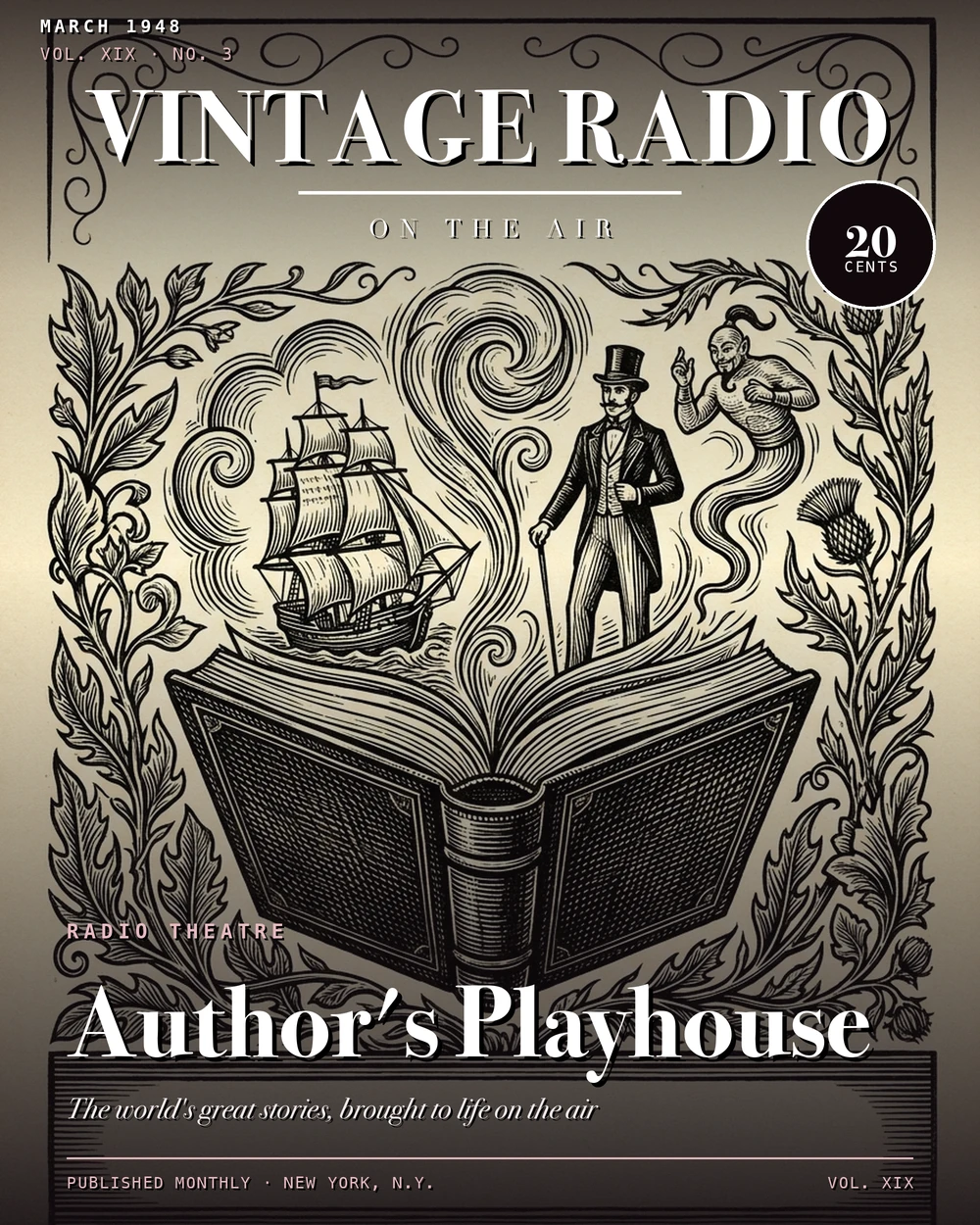
Author's Playhouse
Literature on the Air
What set Author's Playhouse apart from the crowded field of radio drama in the early 1940s was its commitment to the written word as a starting point. Where many anthology programs built their reputations on Hollywood adaptations or original scripts, this series went straight to the page — short stories, novellas, the occasional full novel — and trusted that good writing would carry over into good radio. The approach was deliberate and consistent across the show's run, and it gave the series an identity that was easy to articulate: if an author wrote it, Author's Playhouse might bring it to your radio.
Wynn Wright created the program, which first aired on Mutual in 1940–1941 before moving to the NBC Blue Network on March 5, 1941. It ran on Blue until October of that year, then shifted to the NBC Red Network, where it remained until June 1945. That network journey covered some of the most turbulent years in American broadcasting, and the show kept its format largely intact throughout — a half hour, one story, in and out.
The Literary Range
The premiere set the tone immediately. It adapted "Elementals" by Stephen Vincent Benét, a writer then at the height of his reputation as a poet and storyteller. That opening choice signaled what the series intended to be: not light entertainment padded around commercials, but genuine engagement with American and international literature.
From there, the range widened considerably. James Thurber's "The Secret Life of Walter Mitty" made it to the air, as did Paul Gallico's "The Snow Goose" and W.W. Jacobs's "The Monkey's Paw" — stories that had already proven themselves on the page and translated with real power to the sound medium. William Saroyan's "The Piano" appeared alongside Nelson Bond's "Mr. Mergenthwirker's Lobbies," giving the series a mix of the celebrated and the slightly left-of-center.
The show also drew from the classics without being stuffy about it. An adaptation of Robert Browning's "The Pied Piper of Hamelin" sat in the catalog alongside H.G. Wells's "The Inexperienced Ghost" and O. Henry's "Christmas by Injunction." What unified these choices was their source in strong, distinctive writing rather than any single genre or national tradition. The series also made room for writers seldom heard on radio — Lafcadio Hearn and L. Ron Hubbard among them — which gave it a reach that more conservative anthology programs rarely attempted.
The People Behind It
Production was handled by a rotating team that kept the sound consistent even as the material shifted week to week. Norman Felton, Homer Heck, and Fred Weihe shared directing duties over the course of the run. Felton in particular would go on to a long career in television production, and his work on programs like this one was part of how he developed the instinct for story pacing that later defined his screen work.
The music fell to three orchestra conductors — Joseph Gallicchio, Rex Maupin, and Roy Shield — who used original scores to underline each story's particular mood. That kind of dedicated musical investment wasn't universal in radio drama, and it contributed to the textured sound the series was known for. Sound effects filled in the rest, building the auditory world the adaptation required, whether that was a coastal marsh for "The Snow Goose" or a haunted house for a Wells story.
On the performance side, the cast included Curley Bradley, John Hodiak, Marvin Miller, Nelson Olmsted, Fern Persons, Olan Soule, and Les Tremayne. Hodiak in particular was making a name for himself in radio before his film career took off, and his presence on the program was a sign of the level of talent the series could attract. The anthology format meant these performers moved through different roles from episode to episode, which demanded flexibility and kept the acting from settling into formula.
The Sponsor Years and the NBC Run
Philip Morris came on as sponsor between 1942 and 1943, giving the program commercial backing during what was arguably its most active period. The arrangement was fairly typical for the era — a single advertiser, a consistent time slot, a stable production environment — and it allowed the show to operate without the instability that plagued some of its anthology contemporaries.
In 1944, the series served as the summer replacement for Truth or Consequences on NBC, which placed it in front of a large audience that might not have sought it out on its own. Summer replacement slots were a double-edged proposition for literary programming — the audience was bigger, but it was also less self-selected — and Author's Playhouse held its format through the run regardless.
The final broadcast aired May 21, 1945, closing out a run that had stretched across four years and two NBC networks. The timing placed it at the tail end of the war years, when radio drama as a form was still vigorous but the landscape was beginning to shift.
What It Left Behind
Author's Playhouse is considered a direct precursor to several later NBC literary programs, including The World's Great Novels, NBC Presents: Short Story, and The NBC University Theater. Those series built on the same basic premise — that radio audiences would engage seriously with adapted literature — and their existence in the late 1940s and early 1950s suggests the model Author's Playhouse helped establish had real staying power inside the network.
In the broader history of radio anthology drama, the show is remembered alongside programs like Academy Award Theater and Lux Radio Theatre, though it occupied a different space. Where those series often led with star power and Hollywood material, Author's Playhouse led with the source text. That distinction mattered then and gives the series its particular character in retrospect.
Thirty-eight known episodes survive from the run, representing stories by writers as different from each other as Thurber, Wells, Saroyan, O. Henry, and Benét. That range is probably the clearest record of what the program was trying to do — not to specialize narrowly, but to demonstrate how wide the territory of serious storytelling actually was, and what radio could do when it took that territory seriously.